
802. 找到最终的安全状态
802. 找到最终的安全状态
🟠 🔖 深度优先搜索 广度优先搜索 图 拓扑排序 🔗 力扣 LeetCode
题目
There is a directed graph of n nodes with each node labeled from 0 to n - 1. The graph is represented by a 0-indexed 2D integer array graph where graph[i] is an integer array of nodes adjacent to node i, meaning there is an edge from node i to each node in graph[i].
A node is a terminal node if there are no outgoing edges. A node is a safe node if every possible path starting from that node leads to a terminal node (or another safe node).
Return an array containing all thesafe nodes of the graph. The answer should be sorted in ascending order.
Example 1:
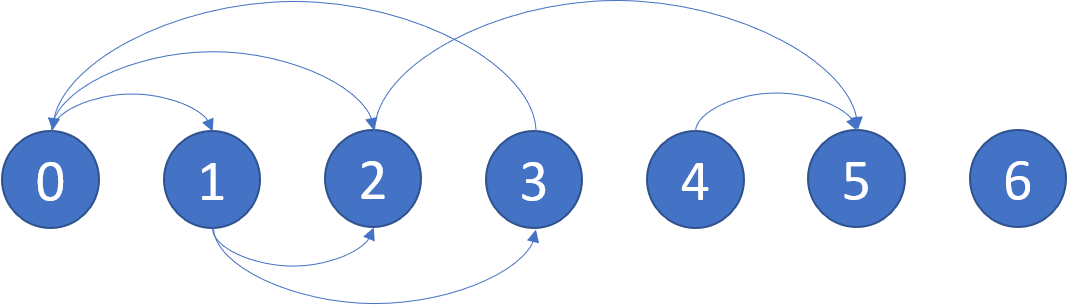
Input: graph = [[1,2],[2,3],[5],[0],[5],[],[]]
Output: [2,4,5,6]
Explanation: The given graph is shown above.
Nodes 5 and 6 are terminal nodes as there are no outgoing edges from either of them.
Every path starting at nodes 2, 4, 5, and 6 all lead to either node 5 or 6.
Example 2:
Input: graph = [[1,2,3,4],[1,2],[3,4],[0,4],[]]
Output: [4]
Explanation:
Only node 4 is a terminal node, and every path starting at node 4 leads to node 4.
Constraints:
n == graph.length1 <= n <= 10^40 <= graph[i].length <= n0 <= graph[i][j] <= n - 1graph[i]is sorted in a strictly increasing order.- The graph may contain self-loops.
- The number of edges in the graph will be in the range
[1, 4 * 104].
题目大意
有一个有 n 个节点的有向图,节点按 0 到 n - 1 编号。图由一个 索引从 0 开始 的 2D 整数数组 graph表示, graph[i]是与节点 i 相邻的节点的整数数组,这意味着从节点 i 到 graph[i]中的每个节点都有一条边。
如果一个节点没有连出的有向边,则该节点是 终端节点 。如果从该节点开始的所有可能路径都通向 终端节点 ,则该节点为 安全节点 。
返回一个由图中所有 安全节点 组成的数组作为答案。答案数组中的元素应当按 升序 排列。
示例 1:

输入: graph = [[1,2],[2,3],[5],[0],[5],[],[]]
输出:[2,4,5,6]
解释: 示意图如上。
节点 5 和节点 6 是终端节点,因为它们都没有出边。
从节点 2、4、5 和 6 开始的所有路径都指向节点 5 或 6 。
示例 2:
输入: graph = [[1,2,3,4],[1,2],[3,4],[0,4],[]]
输出:[4]
解释:
只有节点 4 是终端节点,从节点 4 开始的所有路径都通向节点 4 。
提示:
n == graph.length1 <= n <= 10^40 <= graph[i].length <= n0 <= graph[i][j] <= n - 1graph[i]按严格递增顺序排列。- 图中可能包含自环。
- 图中边的数目在范围
[1, 4 * 104]内。
解题思路
题目要求找出所有 最终安全的节点。如果从某节点出发,不会进入任何环,则该节点为最终安全节点。因此,任务可以归结为图中 判断哪些节点不在环内。
可以采用 深度优先搜索(DFS) 来检测环:
- 辅助数组:
visited[i]: 标记节点i是否已被访问过。inStack[i]: 标记节点i是否在当前递归栈中。
- DFS 检测环:
- 遍历图中所有节点,调用
hasCycle检测是否有环。 - 如果当前节点已在递归栈中(
inStack[node] == true),说明存在环,返回true。 - 如果当前节点已经访问过(
visited[node] == true),直接返回false,说明该节点无环。 - 对当前节点的邻居递归检查,若任何邻居存在环,则当前节点也在环内。
- 如果当前节点没有形成环,从递归栈中移除(
inStack[node] = false)。
- 遍历图中所有节点,调用
- 找出安全节点:
- 遍历
inStack数组,找到所有不在环中的节点。 - 安全节点是那些最终
inStack[node] == false的节点。
- 遍历
- 返回结果:
- 输出所有安全节点的索引。
复杂度分析
- 时间复杂度:
O(V + E),其中V是节点数,E是边数,每个节点和边最多访问一次。 - 空间复杂度:
O(V),主要是辅助数组visited和inStack以及递归栈的开销。
代码
/**
 * @param {number[][]} graph
 * @return {number[]}
 */
var eventualSafeNodes = function (graph) {
	const n = graph.length;
	const visited = new Array(n).fill(false); // 标记节点是否访问过
	const inStack = new Array(n).fill(false); // 标记节点是否在递归栈中

	// 检测是否存在环
	const hasCycle = (node) => {
		if (inStack[node]) return true; // 当前节点在递归栈中,说明形成环
		if (visited[node]) return false; // 已访问且无环
		visited[node] = true; // 标记已访问
		inStack[node] = true; // 将当前节点加入递归栈
		for (let neighbor of graph[node]) {
			if (hasCycle(neighbor)) {
				return true; // 发现环
			}
		}
		inStack[node] = false; // 当前节点出栈
		return false; // 无环
	};

	// 遍历所有节点,检查环
	for (let i = 0; i < n; i++) {
		hasCycle(i);
	}

	// 找出最终安全的节点
	const safeNodes = [];
	for (let i = 0; i < n; i++) {
		if (!inStack[i]) {
			safeNodes.push(i); // 不在环中的节点是安全节点
		}
	}

	return safeNodes;
};
相关题目
| 题号 | 标题 | 题解 | 标签 | 难度 | 力扣 |
|---|---|---|---|---|---|
| 2392 | 给定条件下构造矩阵 | 图 拓扑排序 数组 1+ | 🔴 | 🀄️ 🔗 |